After graduating from her rural Pennsylvania high school in 2005, Tesla Rae Moore did what most American high school seniors today expect to do: she left home for college with her sights on a four-year degree. But when she was a sophomore in nursing school at the University of Pittsburgh at Bradford, the unexpected intervened: she became pregnant with her son.
“It was a high-risk pregnancy, and I decided to stop the program,” she said. Moore returned to her hometown of Kane, a community of about 3,500 in northwestern Pennsylvania. At first intending just to take a break, she ended up dropping out. “I was going to go back, and then it was just one of those things,” she said. “Life happened.”
Moore didn’t lose her desire to return to college; she just couldn’t figure out how to make it work. As a single mom, she couldn’t quit her job. Moreover, getting to Pitt-Bradford, the nearest four-year institution, required a ninety-minute round-trip commute. The closest two-year college, in Butler County, was a two-hour drive each way. Online-only classes might have been a solution, but Moore felt she needed more structure to succeed. “Especially for somebody that’s been out of school, it takes a lot of discipline,” she said.
They’re a tempting alternative to raising taxes, but their long-term costs far outweigh the revenue they bring in.
Originally published in Governing, September 2018.
Raising taxes is painful. That may be why, since 2010, 47 states and a number of cities have instead raised both civil and criminal fines and fees. These increases are often viewed as a conflict-free way to plug budget holes.
In the last decade, for example, New York City grew its revenues from fines by 35 percent, raking in $993 million in fiscal 2016 alone. The monies came largely from parking and red light camera violations, as well as stricter enforcement of “quality of life” offenses such as littering and noise. In California, routine traffic tickets now carry a multiplicity of revenue-boosting “surcharges.” As a result, the true price of a $100 traffic ticket is more like $490 — and up to $815 with late fees, according to the Lawyers’ Committee for Civil Rights of the San Francisco Bay Area.
This increasing reliance on fines and fees comes despite what we learned following the shooting in 2014 of Michael Brown by a police officer in Ferguson, Mo. A federal investigation of the city’s police department subsequently revealed that as much as a quarter of the city’s budget was derived from fines and fees. Police officers, under pressure to “produce” revenue, extracted millions of dollars in penalties from lower-income and African-American residents. In 2017, the U.S. Commission on Civil Rights issued a follow-up report finding that the “targeting” of low-income and minority communities for fines and fees is far from unique to Ferguson.
This potential for injustice is one reason why states and cities should be weaning themselves from fines and fees. Another is that these revenue boosters carry economic costs that far outweigh the short-term revenue gains.
Because the burden of these penalties falls disproportionately on people who can’t afford to pay, jurisdictions collect far less than expected and waste resources chasing down payments that won’t materialize. In California, increased fines and fees have resulted not in a treasury flush with cash but in $12.3 billion in uncollected court debt as of 2016. A 2014 study of Alabama court costs also found abysmal collection rates — under 10 percent on average — despite countless hours spent by staff pursuing payment.
States can further see net losses if driver’s licenses are suspended or residents are incarcerated for nonpayment. The report by the Commission on Civil Rights found that in some jurisdictions as many as one-fourth of local inmates were in jail for nonpayment of fines and fees. The fiscal impacts of this policy are obvious. In addition to its direct expenses, incarceration — even short stints in jail — can lead to costly outcomes, including unemployment, dependence on public benefits and greater risk of crime.
Nearly as damaging — and far more common — are driver’s license suspensions. The Washington Post reported that more than 7 million people nationwide may have had their licenses suspended because of traffic debts. These suspensions have economic consequences. “People can’t drive and go to work, which means they can’t pay the fines and fees or support their families,” says Joanna Weiss, co-director of the Fines and Fees Justice Center.
A few jurisdictions are rethinking these revenue generators. In the lead is San Francisco, which established the Financial Justice Project dedicated to fines and fees reform. Promising efforts are also afoot in cities and states, including California, Illinois, New York City, Philadelphia and Washington state. Some jurisdictions are working to end license suspensions — a trend that could accelerate after a federal judge recently ruled the practice unconstitutional in Tennessee. Other places are considering non-monetary penalties, such as community service or instituting so-called day fines or payment plans based on the ability to pay. In San Francisco, for instance, a newly instituted payment plan for low-income residents has already quadrupled the parking fines being paid.
The bottom line: Despite the short-term boosts civil and criminal fines and fees appear to bring, the long-term cost to cities, states and their residents is likely to be far greater.
Geography is a barrier to higher education for tens of millions of rural Americans. A few states have hit on an innovative solution.
Via Washington Monthly
After graduating from her rural Pennsylvania high school in 2005, Tesla Rae Moore did what many, perhaps most American high school seniors today expect to do: she left home for college with her sights set on a four-year degree. But when she was a sophomore in nursing school at the University of Pittsburgh at Bradford, the unexpected intervened: she became pregnant with her son.
“It was a high-risk pregnancy, and I decided to stop the program,” she said. Moore returned to her hometown of Kane, a community of about 3,500 nestled at the edge of the Allegheny National Forest in northwestern Pennsylvania. At first just intending to take a break, she ended up dropping out. “I was going to go back, and then it was just one of those things,” she said. “Life happened.”
Moore didn’t lose her desire to return to school; she just couldn’t figure out how to make it work as the years went by and her family grew. “I’m a single mom, and the only income earner, so I couldn’t quit my job to go to school,” she said. “And if I took classes all day, I’d have to work at night, and who would take care of the kids?” Given her work and family obligations, Moore couldn’t fit in college unless she could attend classes nearby. But getting to Pitt-Bradford, the nearest four-year school, required a round-trip commute of an hour and a half. The nearest community college, in Butler County, was a two-hour drive each way. Moore didn’t have that kind of time to spare. Online-only classes might have been a solution, but Moore felt she needed more structure to succeed. “Especially for somebody that’s been out of school, it takes a lot of discipline,” she said.
A surprising number of Americans face the same problem Moore did. According to the Urban Institute, nearly one in five American adults—as many as forty-one million people—lives twenty-five miles or more from the nearest college or university, or in areas where a single community college is the only source of broad-access public higher education within that distance. Three million of the Americans in these so-called “higher education deserts” lack broadband internet, as well.
Rural America has too few dentists – and too few patients who can pay.
Via the Washington Post.
Lynnel Beauchesne’s dental office hugs a rural crossroads near Tunnelton, W.Va., population 336. Acres of empty farmland surround the weathered one-story white building; a couple of houses and a few barns are the only neighbors. But the parking lot is full. Some people have driven hours to see Beauchesne, the sole dentist within 30 miles. She estimates that she has as many as 8,000 patients. Before the office closes at 7 p.m., she and her two hygienists will see up to 50 of them, not counting emergencies.
About 43 percent of rural Americans lack access to dental care, according to the National Rural Health Association, and West Virginia, among the poorest and most rural states, is at the center of the crisis.
In the aftermath of President Donald Trump’s election and inauguration, former Democratic presidential candidate Sen. Bernie Sanders urged Democrats to remake themselves as warriors in opposition to big business as the strategy for winning back voters.
“We need to … make it crystal clear that the Democratic Party is going to take on Wall Street, it’s going to take on the greed of the pharmaceutical industry, it’s going to take on corporate America that is shutting down plants in this country and moving our jobs abroad,” Sanders said on CNN in February 2017.
Many progressives have taken that advice to heart. As in many past election cycles, corporate- bashing rhetoric has been the bread-and-butter of many progressive candidates and their supporters pressing for greater governmental intervention on issues such as corporate governance, wages, and worker benefits.
The grassroots group “Justice Democrats,” for instance, is so far endorsing 52 candidates they say “represent people, not corporations,” while “putting Main Street before Wall Street” has become a reliable campaign trope. Other activist organizations are rallying their constituencies against “powerful CEOs” who have been “rigging the economy against working families for decades.”
These instincts are understandable, given the many ways the nation’s current prosperity seems to be bypassing average Americans. Corporate earnings have hit their highest mark since 2011, yet wage growth has been sluggish. Newly mandated disclosures reveal eye-popping disparities between CEO and worker salaries – one study finds the median CEO now makes 140 times as much as the median employee. Many Americans – particularly “gig” workers – seem cast adrift on the economy, with less access to traditional employer-sponsored benefits such as health care and retirement.
But, as a comprehensive economic message and agenda, “fighting big business” unfortunately won’t lead to the kinds of policies workers need.
America’s official unemployment rate now stands at 3.9 percent, which has been cause for much crowing by President Donald Trump. New data, however, belie Trump’s triumphalism on the economy and find that many ordinary Americans are far from confident about their personal economic circumstances.
A new survey by Prudential and Morning Consult finds that just 46 percent of Americans are “hopeful” about their financial security, while 48 percent are “worried” or “very worried.” One in four say they’re saving less for retirement because of their current finances, 27 percent say they’ve taken a second job, and 34 percent say they’ve looked for a new job in an effort to increase their pay.
Fears about retirement security in fact loomed large in this survey, with 72 percent of workers saying they were concerned about their retirement and 80 percent ranking it as the top issue they’d like to see Congress tackle. According to the poll, the principal reasons workers gave for having trouble saving were “daily expenses” (29 percent), housing costs (18 percent), elder care (17 percent) and health care (13 percent).
Why so much anxiety despite nothing but positive toplines on the economy?
One reason is wage stagnation. While corporate profits might be reaching record highs, wage growth has been sluggish. According to the Bureau of Labor Statistics, real average weekly earnings in April were just 0.4 percent higher than they were a year ago. Meanwhile, household expenses have been rising at a much faster pace. Average annual premiums for employer-sponsored health insurance, for instance, have risen 19 percent since 2012 and 55 percent since 55 percent since 2007, according to the Kaiser Family Foundation.
A second reason for Americans’ persistent economic anxieties is escalating levels of debt. This week, the Federal Reserve Bank of New York released new data showing an increase in household debt for the 15thconsecutive quarter. As of March 31, U.S. households owed $13.2 trillion, up $63 billion from the fourth quarter of 2017. Student loans were the largest source of debt behind mortgages, outstripping auto loans and credit cards to total $1.41 trillion in the first quarter of 2018.
A third source of household anxiety is growing job insecurity, as mounting numbers of workers enter the “contingent” or “gig” economy. While the precise size of this new economy is under dispute, the Prudential-Morning Consultsurvey found that 27 percent of workers – including 35 percent of millennials – characterized themselves as gig workers and that 30 percent of respondents said someone in their immediate family worked a gig job. Despite their claimed benefits of flexibility and independence, gig work is also seen as insecure – 64 percent of Americans said gig jobs “fail to provide necessary worker benefits.”
Americans’ worries about their finances should also add to the worries of the GOP, which is already highly vulnerable this fall. The President’s much-touted tax cuts have done little to help average families, who might be starting to see the extent to which they’ve been hoodwinked by Trump and GOP promises. Surveys show, for instance, that voters are beginning to pin higher health care costs on Republican recalcitrance over Obamacare – one late 2017 survey found that 50 percent of Americans would blame Trump and Republicans if costs increase and people lose coverage, versus 37 percent who would blame Democrats and former President Barack Obama.
Progressives, on the other hand, now have a chance to point out the failures of Trump’s economic plan and offer their own prescriptions for change. At the top of that list should be strategies to help Americans earn their way to greater financial security through better jobs, higher wages and greater opportunities for advancement. One promising blueprint is the economic opportunity agenda released this week by the House New Democrat Coalition, which offers a smorgasbord of creative ideas for improving workers’ skills and ensuring they are well-equipped to thrive in a changing economy. Among other things, the Coalition calls for an overhaul of higher education so that students not only emerge from school with immediately marketable skills but have a chance to upgrade themselves throughout their working lives.
By embracing a forward-thinking agenda that gives Americans a clear path forward and upward, progressives can shift the political winds in their favor and help to defeat the underlying forces that propelled the rise of Trumpism and its destructive policies.
As the party out of power, Democrats have the luxury of thinking big as they consider how to topple President Donald Trump in 2020. Bold, ambitious ideas are what the party sorely needs if it is to capture voters’ attention and woo them from Trump’s corrosive grip.
But if Democrats are to craft a winning agenda for 2020, bigness and boldness alone are insufficient; political feasibility and substantive plausibility are also necessary ingredients. That’s why the latest big and bold idea catching the eye of potential 2020 contenders – a federal jobs guarantee – is ultimately a disappointment.
Touted by advocates as a way to achieve “permanent full employment,” the notion of a federally guaranteed job for anyone who wants one has won support from three rumored presidential hopefuls so far, including New York Sen. Kirsten Gillibrand, Vermont Sen. Bernie Sanders and New Jersey Sen. Cory Booker. Last week, Booker revealed draft legislation3 to pilot a federal jobs guarantee program in up to 15 localities nationwide, while Sanders has floated a much more ambitious national plan4 focused on public works projects at a scale not seen since the Great Depression. Under both proposals, participants would earn wages of up to $15 an hour, along with benefits such as paid family and sick leave and health insurance. “There is great dignity in work – and in America, if you want to provide for your family, you should be able to find a full-time job that pays a fair wage,” said Booker in a press release announcing his effort.
Booker’s endorsement speaks to the inherent surface appeal of a jobs guarantee. To borrow President Bill Clinton’s famous formulation, Americans who “work hard and play by the rules” deserve a shot at self-sufficiency, and the promise of work for all who want it invokes Americans’ innate sense of fair play. Proponents also rightly point out stark disparities in employment between certain groups, the result of discrimination and other structural barriers that guaranteed access to meaningful employment could arguably remedy.
Unfortunately, the idea also suffers from a variety of fatal defects, including its size, timing and relevance and any number of practical obstacles that make it administratively unworkable as well as politically untenable. For one thing, it rests on the dubious assumption that the American electorate – at a time when public cynicism and distrust toward government remain at all-time highs6 – is ready to embrace a dramatically expanded role for the federal government as the nation’s largest staffing agency and employer. More fundamentally,
the idea betrays a deep lack of faith in the inherent resilience of the American economy and its people to weather disruption and change. Most Americans don’t share the left’s inordinate confidence in government’s ability to engineer shared prosperity from the top down. Aggressive advocacy of a panacea like government guaranteed jobs can only reinforce public impressions that progressives will always default to “big government” as the solution to complex economic problems.
Low unemployment rates mask soft spots in the job market, especially among rural Americans and minorities.
For the last several months, Republicans have been resting on the laurels of positive job growth and low unemployment — proof, they say, of the Trump economy’s strength. In March, the nation’s official jobless rate stood at 4.1 percent, the lowest it’s been since the peak of the Great Recession and a level that many economists say is at or approaching “full employment.”
Certainly on paper, the labor market looks to be nearly as tight as it was during past expansions, such as during the boom of the late 1990s and early 2000s. In reality, however, the low official unemployment rate masks some serious weaknesses in the economy, including in the parts of the country that are the strongholds of Trump’s support.
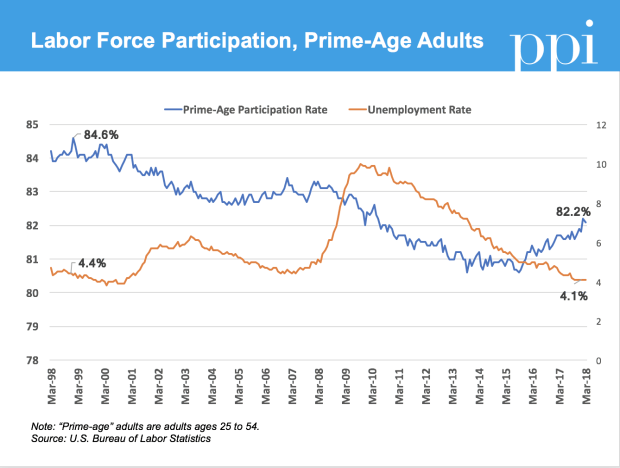
Rural job growth, for example, is lackluster in comparison to that of cities. And while college graduates and the highly-skilled are in demand, minorities and lesser-skilled workers are still struggling. The share of people actually participating in the labor market is also significantly lower than in the past, including among “prime-age” adults between the ages of 25 and 54 who are the backbone of the job market. Simply put, fewer Americans are working or even looking for jobs. This means the decline in jobless rates reflects to some extent a shrinking pool of Americans looking for work.
In March, for instance, the total share of Americans participating in the workforce was more than four percentage points lower than it was in February 2000 — the last time the unemployment rate was as low as it is today. The share of prime-age adults in the workforce was also down by more than two percentage points in comparison to 2000.
The decline in workforce participation is in fact the biggest challenge that must be solved if “full employment” will ever be truly achieved. What isn’t yet clear is exactly why this decline has happened and how to fix it.
While some analyses attribute the continuing decline in workforce participation to demographic shifts, such as the retirement of Baby Boomers and extended schooling for young adults, this doesn’t explain why so many prime-age workers are missing from the strongest job market in years. A 2014 analysis by the Council of Economic Advisers concluded that demographics explains only about half of the decline in workforce participation, while as-yet-unexplained “other factors” account for much of the rest.
There are, however, some strong clues about what these “other factors” could be, such as a geographic mismatch between where new jobs are being created and where people live; workers lacking the right skills for the jobs being created; and lingering structural discrimination. These factors are, in fact, evident from an analysis of who is missing out on the benefits of the recovery:
Rural Americans
Many rural Americans, for example, are facing far less rosy job prospects than their urban counterparts. The number of non-metro jobs still hasn’t caught up to pre-recession levels and even dropped in two of the last five years.
Rural areas are moreover suffering from a double whammy of higher-than-average unemployment rates and lower workforce participation. For instance, while the official rural jobless rate stood at 5.4 percent at the end of the second quarter in 2016 (compared to 4.8 percent for metro areas), the USDA estimates that the unemployment rate would have been 7.8 percent had workforce participation rates been the same as in 2010.
Cities, in contrast, are booming, as regional inequality continues to worsen. According to the Bureau of Labor Statistics, 313 of the nation’s 388 metro areas saw net gains in job growth over the last year. More than two dozen cities report official unemployment rates of less than 3 percent. The biggest winners are, predictably, places such as New York, Dallas and Los Angeles, each of which added 100,000 or more jobs in the last year.
Workers without higher education
Workers with the least skills are also failing to prosper in comparison to their better-educated counterparts. In March 2018, the unemployment rate among workers with a bachelor degree was just 2.2 percent, or about half the rate for workers with a high school diploma or less than a high school education. These figures, however, don’t fully convey the disparities in employment between the best- and least-educated workers.
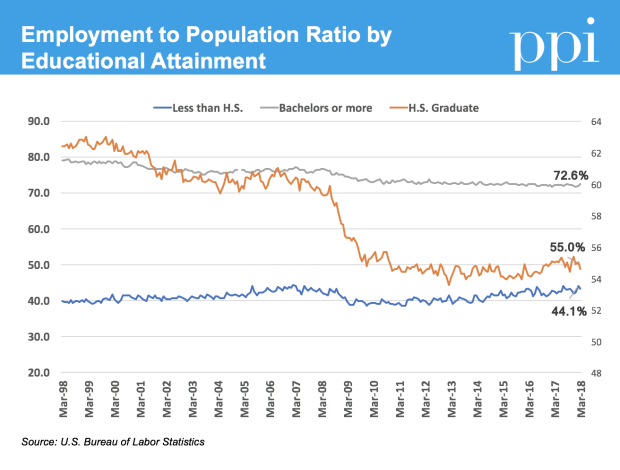
Because the unemployment rate only includes those actively looking for jobs, a better gauge of the prevalence of work is the “employment-to-population ratio,” which also includes individuals not in the workforce. Under this measure, the inequality in work experience between highly educated and less-educated workers is much more stark.
As the following chart shows, just 44.1 percent of Americans without a high school diploma and 55.0 percent of high school graduates work, versus close to three-quarters of workers with a bachelor’s degree or better.
African American men
Another group that could and should be doing better is African-American men. In March 2018, the unemployment rate among black men was nearly double that of whites — 6.1 percent versus 3.3 percent.
Again, however, the true story is in the employment to population ratio, which shows that although both groups have seeing declining employment, lack of work is far more pervasive among African-American men and among prime-age men in particular. While 87.1 percent of prime-age white men were working in March, the equivalent figure among black prime-age men was nearly 10 percentage points lower, at 77.6 percent.
While the official numbers might say the nation is at “full employment,” there’s much more slack in the labor market than the official numbers night suggest. At the same time that some employers have begun to worry about unfilled job openings and upward pressure on wages, millions of Americans are missing out on new opportunities, either because they live in the wrong place or lack the right skills.
One potential result of this patchy recovery is a worsening of the already significant gulf between the economic haves and have-nots, especially if prosperous metro areas continue to grab the lion’s share of new jobs while vast swathes of the country lose out. These disparities in turn will only further inflame the social and political resentments now dividing the country while making it that much harder for the workers falling behind to catch up.
Although continued strong growth could eventually lift more boats, the workers most likely to benefit are the easiest to employ, with adequate access to jobs and enough basic skills to get through the door. The market alone won’t solve the mismatches in skills and geography that are acting as structural barriers to true full employment. Instead, it’s up to policymakers to make that happen.
For many students, the burden of student debt lingers years after leaving college, dragging down their financesand household security. New federal data find that, 12 years after enrollment, students with debt still owed, on average, two-thirds of what they had borrowed –and as many as 27 percent had defaulted.
Colleges, however, face no equivalent long-term financial stake in their students’ education: their obligations are done once the tuition is paid and the last exam is graded. Except perhaps for the pressure to put on a good show for U.S. News
& World Report’s college rankings, schools have little incentive to ensure their students can land good jobs with decent pay – let alone graduate. Students bear the full risk of their investment and cope with the fallout if things don’t pan out as planned.
This lopsided burden of risk is one reason a dramatic expansion in financial aid – i.e., “free college” – can’t solve the crisis in college affordability. Schools would see no need to rein in their costs or to share the risks of investing in education with their students. In fact, the opposite. If the government is willing to pick up more of the tab for students, there’s no reason that tab wouldn’t simply grow – with potentially no reduction in student debt.
What’s needed instead is to break the paradigm of how higher education is financed. That means new mechanisms that both lower the cost of college for students and hold schools more accountable for how their graduates fare in the job market.
U.S. companies are on track to see dramatic reductions in their tax rates, thanks to the $1.5 trillion tax cut package passed by the GOP-led Congress and signed by President Donald Trump in late 2017.
Unfortunately, it’s far more likely that shareholders, not U.S. workers, will reap the biggest benefits from the Trump tax cuts, despite a handful of companies that have handed out “Trump bonuses” and pledged to pay their workers more.
If we really want companies to do right by their workers, we need stronger incentives. One way to do this is to establish a preferential tax rate for companies that organize themselves as “benefit corporations,” a new legal structure that allows corporations to pursue missions other than just profit.






 Anne Kim