The companies secretly profiting off ICE

Earlier this year, 55-year-old Cuban immigrant Geraldo Lunas Campos died at an ICE detention facility on the grounds of Fort Bliss, Texas. Officials claimed Campos had been “in distress,” and guards had been trying to help. But his death was ruled a homicide, the result of “asphyxia due to neck and torso compression.” Charges have yet to be filed; it’s unclear if an investigation is even pending.

That’s not the only peculiarity surrounding Campos’s death. 

The detention center where Campos was killed was built by Acquisition Logistics, LLC, a private contractor with no experience building these kinds of facilities. Yet it won a whopping $1.2 billion contract to perform the work. Even stranger, the company has no website, and its official address is a “a modest home in suburban Virginia owned by a 77-year-old retired Navy flight officer,” according to the Associated Press. (See a photo here.)

Ten years ago, ICE’s annual allotment from Congress was less than $6 billion. But thanks to President Donald Trump’s mass deportation campaign, and the GOP’s “One Big Beautiful Bill” passed last summer, ICE’s budget has ballooned to $85 billion over the next four years, including $45 billion for immigrant detention. 

The result has been a bonanza for what the Brennan Center calls the “deportation industrial complex”—the host of private contractors profiting from ICE’s nationwide rampage. Companies like Core Civic and The GEO Group, the nation’s largest private prison contractors, are gorging at the trough, as well as scores of anonymous upstarts like Acquisition Logistics, LLC. Oversight seems minimal, and transparency is almost nil. 

Stock prices for Core Civic and The GEO Group surged after the 2024 election, in anticipation of the moneymaking to come. Core Civic’s shares, for instance, leapt from $13.69 in late October to $21.24 on the day of Trump’s inauguration. Last November, the company told investors that its third-quarter revenues were up 18 percentcompared to the same period in 2024. 

Likewise, the value of GEO Group’s shares more than doubled, from $14.45 in late October to a peak of $35.35 the week before Trump took office. According to USASpending.gov, Core Civic has won more than $700 million in federal contracts for fiscal 2025 and 2026, while the GEO Group has been awarded more than $1.5 billion(not all of these sums are from contracts with ICE). In an earnings call for investors this week, The GEO Group reported winning $520 million in new contracts in 2025—“the largest amount of new business we have won in our company’s history,” according to company executives. 
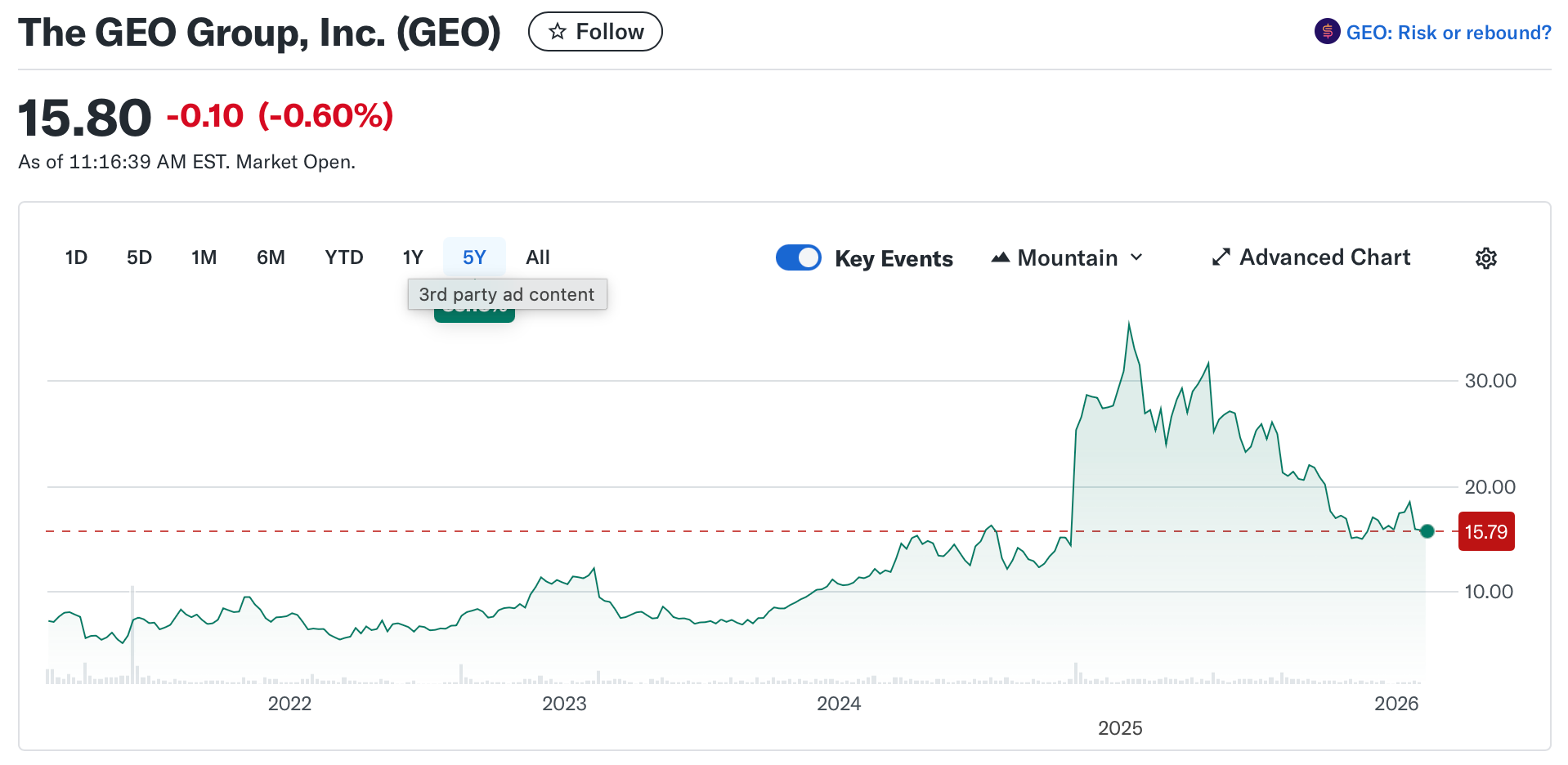
Stock prices for private prison contractor The GEO Group saw a noticeable spike after Trump’s election. Source: Yahoo Finance

Core Civic and The GEO Group are, at least, public companies with publicly traded stock, and federal securities laws require them to file quarterly reports on their financial condition (though Trump has said he’d like to end this requirement). This gives taxpayers some semblance of transparency into their operations and the magnitude of their dealings with the government. 

More troubling are the private concerns like Acqusition Logistics, LLC, who are under no obligation to disclose their revenues from government contracting, how they’re spending their money, or even who their executives are. Databases like USASpending.gov provide only the barest glimpse of the vast cataracts of cash flowing to faceless contractors. For instance: 

  • A Florida company called MetroIBR JV, LLC, was awarded $29.5 million in contracts from the US Customs and Immigration Service, the Office of the Secretary, and the Federal Acquisition Services for “custom computer programming services” related to “immigration examination fees” and “periodic censuses and programs” for the US Census Bureau. No details of these contracts are available. (The Trump administration has called for a citizenship question on the next census.)
  • A New York-based firm called Deployed Resources, LLC, won nearly $300 millionin new contracts from ICE, including for “operations and support,” and “security guards and patrol services.” A Texas Tribune investigation found that the company specializes in building tent encampments (such as after natural disasters) and is building border facilities for detainees. The Tribune also reported that the company has since been awarded nearly $4 billion in contracts from ICE—a figure not reflected in USASpending.gov. 
  • Two mysterious firms—Louisiana-based People Who Think, LLC, and the Delaware-based Safe America LLC—have won more than $220 million in contracts to make ads for the Department of Homeland Security and DHS Secretary Kristi Noem. People Who Think, which has no website, won an award for $77.1 million, while Safe America Media, which also has no website, won contracts totaling more than $142 million. According to an investigation by ProPublica, Safe America was created just days before the bid was awarded, and both firms have ties to Noem or her senior officials. Noem also invoked a “national emergency” to award the contracts outside the usual procurement process, ProPublica reports. “It’s corrupt,” one official told ProPublica.

A keyword search in USASpending.gov for “immigration” turned up 322 contracts for fiscal 2025 and 2026, including $60 million to Price Modern LLC (for furniture “to support enforcement and removal operations”); $2.2 million to Patton Contractors Inc. (to build out an ICE office in New Orleans);  $607,000 to Wildflower International LLC (for fingerprint scanners); etc. etc. etc. This is only the tip of the iceberg. 

Regardless of their ideology, members of Congress should demand far more transparency from the Trump administration about the contracting practices and contractors involved in its ICE operations. Otherwise, the potential for waste—let alone graft—is vast. 

One idea is to extend quarterly reporting requirements to private companies if a majority of their revenues come from government dollars. Under current federal securities laws, public companies are accountable to their investors and must disclose such “material” information as their revenues and liabilities, executive compensation, litigation, and other “risk factors” that might be of interest. Taxpayers, who are essentially “investors” in government contractors, deserve the same basic information. “Private” companies profiting from taxpayer money should be held accountable to the public in the same way that agencies are accountable to Congress (and in fact, contractors are almost always acting on behalf of agencies that have delegated to them their power). 

Of course, transparency is only the first step; accountability and oversight are even more crucial. But given Trump’s penchant for secrecy and self-dealing so far, it’s going to be up to the public to demand the sunlight that will disinfect this administration.

This piece was originally published on the Washington Monthly’s Substack.

China Rising, America Falling

In a remarkable 2005 article for Foreign Affairs, Chinese party official Zheng Bijian first articulated to Western audiences the concept of a “peaceful rise” for China. 

At the time, China was on the cusp of its emergence as a global power, and many US experts feared China’s aggression, both economically and militarily. Bijian’s essay sought to allay these concerns, arguing that China could ascend to “great-power status” in harmony with the international order, rather than in opposition to it. 

Twenty years later, China has indeed attained its goal of becoming an economic superpower. In 2005, China’s GDP (in constant 2015 dollars) was only about $4.5 trillion, less than a third of America’s economic output. In 2024, its GDP had swelled to nearly $18.5 trillion, compared to $22.6 trillion for the US. Certainly, GDP is only the crudest of indicators of economic might, but there’s no denying China’s ascension. 

Just in recent weeks, China has been racking up triumph after triumph, cementing its global stature. In contrast, the United States seems on the fast track to decline, ensuring not just China’s continued rise but its future dominance. 

For instance:

  • Chinese universities grabbed seven out of 10 spots in the just-released Leiden Rankings, based on the quality and volume of scientific research. Harvard University fell to third from the top spot, while the University of Michigan and Johns Hopkins were the only two other US institutions to crack the top 25. Chinese universities now produce 35 percent of all top journal publications, says a new NBER analysis, compared to 15 percent from US schools. 
  • China recently announced the world’s largest-ever trade surplus of $1 trillion in 2025—achieved despite President Donald Trump’s double-digit tariffs on Chinese imports. American manufacturing output, meanwhile, contracted for the tenth straight month, and jobs continued to shrink
  • Chinese automaker BYD is now the world’s largest manufacturer of EVs, selling 2 million cars in 2025. Tesla sales, on the other hand, slumped by 9 percent. 
  • And in a brutal Et tu, Brute moment, Canada announced a new trade deal with China to lower tariffs on EVs, canola, and other products. (Canadian Prime Minister Mark Carney also got a standing ovation at Davos this week with a speech condemning the “rupture” created by Trump’s policies and positioning Canada as a force for global stability.)

Trump’s embarrassing speech at Davos this week reassured no one that America can maintain its pre-eminence, and his policies will only accelerate America’s slide into second place. 

His tariffs, for instance, have burdened American consumers while failing to stimulate domestic growth. Though Trump has touted his “trade deals” with other countries and their pledges to invest, nothing significant has materialized (and nothing, frankly, is likely). 

Trump’s immigration policies have also robbed the nation of critical labor and talent, and the world’s brightest minds are settling elsewhere. New international student enrollment, for example, dropped by 17 percent last fall, while net immigration to the United States was negative for the first time in 50 years. The Brookings Institution estimates a net loss of jobs in 2026 as a result of the loss in migration, along with depressed consumer spending and GDP growth. 

And as much as Trump covets Venezuelan oil, the future belongs to Chinese batteries, as author Dan Wang recently argued in The New York Times and clean energy expert Laura Gillam wrote for the Monthly. China has leapfrogged the United States in its clean energy investments, paving the way for future monopolies on clean energy technology. Trump, meanwhile, is waging war on windmills and pursuing a dead-end strategy to revitalize coal. 

Trump is moreover destroying the seed corn of US competitiveness with his attacks on higher education and funding for scientific research. Though Congress appears to be rebuffing his plans for drastically slashing research, the pauses and cancellations of funding earlier this year have been hugely disruptive to researchers. 

In the years before China’s rise, the United States’ hope was “containment.” Today, we’d be hard-pressed to compete.

This post was first published on the Washington Monthly’s Substack.

The GOP’s war on kids

Last fall, under Democratic Gov. Michelle Lujan Grisham, New Mexico became the first state in the country to offer no-cost universal child care. Beginning November 1, the state eliminated income caps on eligibility for the state’s child care assistance program, opening it to all families regardless of their means. 

Earlier this month, New York Gov. Kathy Hochul and New York City Mayor Zohran Mamdani followed suit with their own extraordinary joint initiative: To deliver free child care to all children under five, beginning with two-year-olds in New York City. 

Both efforts are revolutionary and deserve far more attention than they’ve received so far. 

Free child care would be a godsend to parents who would otherwise spend thousands on tuition, and a blessing for kids who may otherwise not have access to high-quality early childhood education. It’s pro-child, pro-family, and pro-growth. Child care challenges cost the US economy as much as $122 billion a year in lost wages and productivity, according to the First Five Years Fund. 

Republicans and the Trump administration, on the other hand, can only claim to be “pronatalist” and “pro-family.” Their policies have wreaked nothing but destruction on the health and well-being of America’s kids. 

Robbing families of child care. In stark contrast to Hochul, Mamdani, and Grisham, President Donald Trump tried to block child care funding to five Democratic-led states as part of an alleged crackdown on “fraud” last week. (A federal judge called the move illegal.) An earlier announcement had threatened to block federal child care funding to all states absent proof that funds “are being spent legitimately.” Yes, isolated cases of fraud are a problem—and the result of poor governmental oversight—but Trump’s blanket accusation is a pretext for punishing blue states, with families as collateral damage. Whatever regulatory obstacles the administration ultimately imposes will make it harder for all families to access child care. Many providers could go out of business, thereby exacerbating already-dire shortages. 

Jeopardizing children’s health. The Centers for Disease Control and Prevention’s new vaccine guidelines, announced earlier this month, reduce the number of recommended childhood vaccines from 17 to 11—a “radical and dangerous decision,” as epidemiologist Michael Osterholm told NPR. 

Among the immunizations removed from the list is Hepatitis B, credited with reducing the incidence of infection in babies and teens by 99 percent. Absent immunization, 9 in 10 infants infected with Hep B will develop a chronic liver infection, according to the Johns Hopkins University’s Bloomberg School of Public Health, and as many as 25 percent of these patients will eventually die from liver failure. Also off the recommended list is seasonal flu, which has proved unusually virulent this year. North Dakota, for instance, just reported its first pediatric flu deathsin 10 years, and 17 children have died so far nationwide. Nevertheless, Health and Human Services Secretary RFK, Jr. recently told CBS News that it might be a “better thing” if fewer kids got flu shots. 

The Trump administration’s anti-vax posture has already helped ignite measles outbreaks in multiple states. South Carolina, for example, is currently dealing with more than 300 cases, primarily among unvaccinated children. Expect these epidemics to become more frequent—and deadly. 

Wrecking public schools. Trump’s administration has waged a systemic assault on public education, beginning with the dismantling of the Department of Education by executive order this spring. This summer, Trump also froze billions in federal education funds granted by Congress until bipartisan pressure forced him to release the money. His 2026 budget request demands steep cuts in education funding and zeroes out grants for rural education as well as programs like McKinney-Vento, which provides support to homeless students. 

The massive budget cuts included in the “One Big Beautiful Bill Act” passed by Congress last summer will also ratchet up financial pressure on public schools. Billions of dollars in cuts to Medicaid and SNAP, for instance, could force cash-strapped states to cover shortfalls by slashing school funds. Program changes will also pummel school budgets directly, according to the School Superintendents Association. Medicaid helps fund school nurses, psychologists, and services for students with disabilities, and less funding will mean fewer services for needy kids. 

Trump’s greatest hostility is reserved for the children already most at risk: kids who are transgender, kids with disabilities, kids who are undocumented, or who have undocumented parents. 

Like any schoolyard bully who targets the smallest child on the playground, Trump has unleashed his cruelest instincts on America’s most vulnerable. Among the many heartbreaking incidents this year was the March deportation of an 11-year-old girl with brain cancer, along with her undocumented parents. Advocates have asked for “humanitarian parole” so the girl could continue her treatment, but as of last fall, federal immigration authorities hadn’t even bothered responding

If a society is judged by how it treats its weakest members, all Americans should stand ashamed.

This post originally appeared on the Washington Monthly’s Substack

Adventures in “Credentialing”

Companies like Google, Meta, IBM and others offer students a chance to earn “professional certificates” online in topics such as data analysis, IT and online marketing. These classes offer convenience and affordability as well as the promise of career advancement.

But can they and other “credentials” available in the burgeoning certificates industry really help you land a well-paying job?

I explored the value of professional certificates in two articles for the Washington Monthly’s 2023 College Guide. In one piece, I provide an overview of the data available on wages and job outcomes for certificate holders. (The bottom line is that there isn’t nearly enough information for students to make good choices.) I also write about how I “earned” a certificate in data analytics and what this says about the problems with online programs.

A link to the full Washington Monthly College Guide is here.

Sharpest drop in college enrollment is among Black and Latino men

From 2019 to 2021, male undergraduate enrollment dropped by 10.2 percent, according to the National Student Clearinghouse, compared to 7.8 percent among women. Among Black men, however, enrollment fell by 14.8 percent overall, and a whopping 23.5 percent among those enrolled in two-year schools. Latino male enrollment similarly slumped: by 10.3 percent overall and by 19.7 percent among community college students.

Read more at Newsweek…

Train in Vain

Advanced College is a for-profit school in South Gate, California, a Los Angeles suburb that’s 95 percent Hispanic. Photos on Google Maps show a one-story beige building with a small parking lot. A banner on a car stereo store next door announces, “No Credit Needed.” Two doors down, there’s a crematorium, and across the street, a burger shop. Advanced College offers only seven programs, according to its website, including a credential in “computerized accounting” (tuition and fees: $13,573), a certificate in phlebotomy ($3,500), and a certificate in vocational nursing ($35,000). 

The Department of Education’s College Scorecard reports that the school had only 31 students and a mere 52 percent completion rate as of July. And despite the name, just 43 percent of Advanced College’s students earn more than they would with just a high school degree. The school is under the dreaded “heightened monitoring” by the Education Department for “financial or federal compliance issues.” 

Nevertheless, Advanced College is among the approximately 1,000 “eligible training providers” as of July 22 (and more than 5,700 programs) approved by the state of California to receive training funds under the Workforce Innovation and Opportunity Act, the federal government’s largest workforce development program. 

Read more at Washington Monthly

Why women and minorities leave STEM careers

I interviewed 25 workers with STEM degrees about the trajectories of their careers. The experiences of the women and minority workers I interviewed could not be more different from the experiences of the white men who spoke with me.

White men spoke of having mentors, robust professional networks and ample opportunities for advancement. Women and workers of color spoke of social isolation, disparate treatment and dead ends.

Is it any wonder that STEM fields continue to have a problem with diversity? Read more from my report for AEI here.

The Fallacy of Meritocracy on America’s College Campuses

In The Merit Myth, In The Merit Myth: How Our Colleges Favor the Rich and Divide America, veteran researchers Anthony P. Carnevale, Peter Schmidt, and Jeff Strohl argue that America’s top colleges and universities uphold a biased infrastructure that props up students from the one percent of U.S. families to the detriment of everyone else.

Read my review of this important book for Washington Monthly here.

How 2020 Democrats are missing the message on the economy

The 2020 Democratic primary has seen no shortage of big, ambitious ideas—the nationalization of health care via “Medicare for All,” free college, free child care, and the cancellation of student debt, just to name a few.

But there’s one big idea still missing: how to fix the stark and growing disparities between the parts of the country that are prospering and those that are falling behind. Regional inequality is perhaps the greatest challenge to America’s economic and political future, but 2020 candidates have yet to tackle, let alone acknowledge, the problem. It’s an omission that could have long-term substantive consequences for Democrats.

Since President Donald Trump took office in 2016, numerous analyses have pointed to a widening gulf—political, economic and demographic—between red and blue America. On the one hand are the rising fortunes of educated, urban Democratic districts. On the other is the steep decline of formerly industrial, Republican districts in rural America and the heartland.

The latest to highlight this trend is a new report from Mark Muro and Jacob Whiton of the Brookings Institution, which underscores how deep this schism has become over the past 10 years.

Continue reading at Washington Monthly.

Anti-Fluoride Activism Is Bad, and Not Just for Public Health

Originally published in Governing, July 2019.

In 1901, a Colorado Springs dentist named Frederick McKay noticed many of his patients had peculiarly mottled brown teeth — but far fewer cavities than the norm. The cause, Dr. McKay determined after years of investigation, was high levels of natural fluoride in the town’s water. His discovery eventually led to the widespread fluoridation of public water systems across America and a dramatic decline in tooth decay over the past 70 years.

Numerous studies have shown the protective effects of adding fluoride to water, especially for kids, and the Centers for Disease Control and Prevention hails community water fluoridation as one of the 20th century’s top 10 public health achievements. State and local budgets have benefited too, thanks to lower public expenditures for dental care.

Unfortunately, a significant number of localities are now undoing their investments in fluoridation, thanks to a small but vocal minority of anti-fluoride activists using pseudo-science to trump data. The result has been the spread of misinformation about fluoride’s benefits, as well as higher costs for both taxpayers and families.

According to the anti-fluoridation Fluoride Action Network (FAN), more than 200 communities in the United States and Canada have rejected public water fluoridation since 2010, from small towns such as Sheridan, Wyo., to bigger jurisdictions such as Bucks County, Pa. In Portland, Ore., residents have voted down fluoridation four times since 1956, most recently in 2013. In 2018, at least 13 communities put water fluoridation on the ballot, while many other localities debated the issue at the city council level without a public vote.

Like anti-vaccinators, anti-fluoride activists rely on spurious medical research to argue fluoridation’s hazards. FAN, for instance, blames fluoride in water for everything from cancer to diabetes to low IQ to, ironically enough, tooth decay. “I’ve got a list as long as your arm of different claims,” says dentist Johnny Johnson, president of the pro-fluoride American Fluoridation Society. None of these claims, however, is backed up by valid science or facts.

One thing that is backed up by facts? Fluoridation saves money — for consumers as well as governments. A 2016 Health Affairs study estimated the nation’s net savings from fluoridation to be nearly $6.5 billion a year from avoided dental costs. Conversely, ending fluoridation can be costly. One study in New York found that residents in non-fluoridated counties were 33 percent more likely to undergo dental procedures, while a Louisiana study found that Medicaid-eligible kids in non-fluoridated communities were three times more likely to get dental treatment than kids in fluoridated areas and at twice the cost.

Dentist David Logan witnessed these impacts firsthand in Juneau, Alaska, where voters ended fluoridation in 2006. The immediate effect, he says, was an increase in cavities among his adult patients, “specifically in older adults where the root surface gets exposed.” Today, his colleagues are seeing many more cavities in kids and at “levels they haven’t seen before in their practicing career.”

All of this is expensive. Logan, now executive director of the Alaska Dental Society, notes that simple fillings cost about $175 in his community, while crowns cost upward of $500. “It’s a very significant amount,” he says, “especially when that cost is disproportionately borne by the public through Medicaid.”

A 2018 study of Juneau’s Medicaid records found that since the end of fluoridation, Juneau’s kids undergo one more cavity-related dental treatment per year than before, at a cost of $300 per child on average. The study also found the highest costs among children under 7, who’ve had no exposure to fluoridated water.

Logan is hopeful this study will help bring fluoride back to Juneau. But he admits he was badly outgunned 12 years ago by the opposition. “You don’t have to have facts. All you need is something sexy to say,” he says. “We had people with lots of letters after their names, but we didn’t put a face on it and got crushed.”

Next time, he says, he’ll be ready, as should all localities where anti-fluoride activists have made a stand. At stake is not just the integrity of science but public budgets and public health.

Continue reading at Governing